
Whether it’s PepsiCo or L’Oréal, this article—the second installment in our TransfoLab series—reveals why integrating AI into large companies is no longer a “nice-to-have” but a “must-have.”
I. AI in Business in 2026: A passing trend or a strategic shift?
The question is no longer “Should we embrace AI?”—that’s already been settled. The real question—the one shaping debates among transformation leaders today—is: at what level of maturity are we operating, and under what conditions does AI truly create value?
This was the focus of the second session of the TransfoLab by FocusTribes, which brought together program directors, CIOs, and transformation leaders from a variety of industries. Two exceptional speakers: an EMEA Deployment Lead at PepsiCo Europe, who is leading the AI deployment in Integrated Business Planning processes, and the former CIO of Data & AI at L’Oréal, who spearheaded transformative initiatives in digitalization from creative development through R&D.
II- Commodity, Mainstream, or Disruptive: What is your company’s level of AI maturity?
Level 1 — Commodity AI: A Standard, Plus an Advantage
Office assistants, content generation, automation of repetitive tasks. These applications improve individual productivity. They have become an industry standard: failing to adopt them creates a competitive disadvantage. Adopting them no longer provides a competitive edge.
As L’Oréal’s former CIO confirmed: “Companies that miss the boat would have a clear competitive disadvantage. But adoption won’t guarantee an advantage.”
Level 2 — Mainstream AI: Optimizing Processes Using Internal Data
Here, we’re no longer talking about individual assistants but rather a common foundation that aligns functions, standardizes decision-making, and redefines responsibilities. AI no longer merely supports decision-making—it structures the discussion. This is the level at which PepsiCo—and, to some extent, L’Oréal—operates in the realm of digital creation.
PepsiCo’s EMEA Deployment Lead adds: “Before, we used to spend hours discussing the numbers. Now, we discuss action plans.” We’re no longer just using a tool; we’re transforming how we work together.
Level 3 — Disruptive AI: Building an Unassailable Competitive Advantage
At this stage, AI is no longer content with simply optimizing. It creates a barrier to entry based on proprietary historical data. A competitor may invest just as much in an LLM, but they cannot recreate 30 years of R&D history. This is the logic behind L’Oréal’s case regarding molecular reformulation.
AI is not automatically strategic. It may merely be a “hygiene” measure. The challenge is to decide at what level you’re playing—and to accept the organizational implications.
III- How PepsiCo uses AI to improve forecast accuracy and align its functions
The problem: each department works with its own figures
PepsiCo Europe operates in 11 countries, with thousands of SKUs, ongoing promotional cycles, and constant negotiations with major retailers. Sales forecasting is strategic: it drives production, logistics, inventory, and ultimately profitability.
Historically: sales reps worked with their customer commitments, finance adjusted figures to ensure the annual plan was met, the supply chain relied on historical data, and marketing incorporated its campaigns. In meetings, teams spent hours debating variances rather than action plans.
The solution: a unified AI forecasting engine (IBP—Integrated Business Planning)
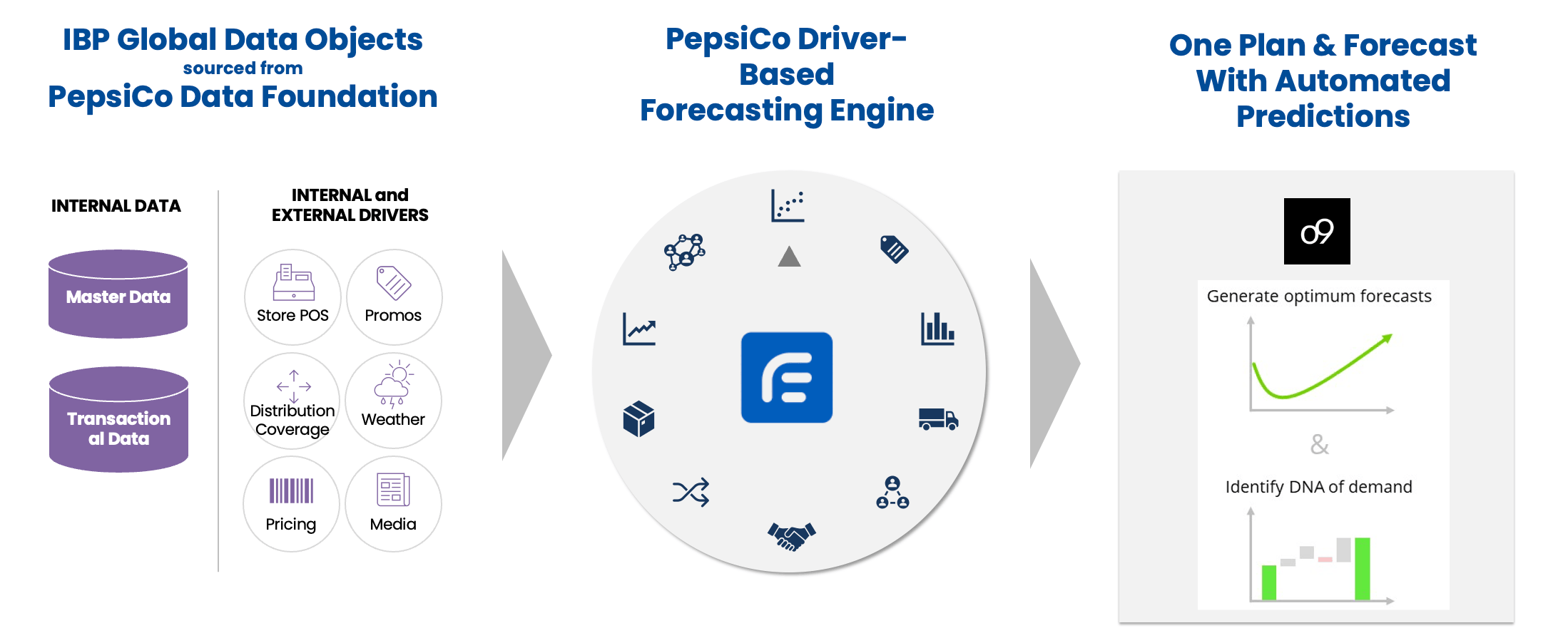
The goal of the IBP program is simple: to create a single plan, shared across all functions, based on an AI-driven forecasting engine. The tool aggregates SAP transactional data, promotional plans, external drivers (weather, pricing), and sales history by customer, product, and channel.
The real breakthrough is organizational: the AI-generated forecast becomes the common foundation. Figures are no longer reworked in parallel in Excel. A key IBP role is created, reporting to the transformation team, to ensure consistency and discipline across cycles.
The results: a 10-point increase in forecast accuracy and a direct impact on net revenue
The results are measurable: forecast accuracy increased to over 70% from ~60% previously, an estimated impact of between +0.5% and +2% on net revenue, and a significant reduction in inventory and obsolescence.
The three factors that made adoption possible
The quality of upstream data — months spent on data cleansing, structuring information systems, and enforcing data entry discipline. AI does not correct a disorganized operation; it forces it to confront its own inconsistencies.
Building trust — business teams were involved in the modeling process from the very beginning, rather than being presented with a finished tool at the end of the process. As our speaker from PepsiCo confirmed, “Trust is something you build. We bring in business experts right from the modeling stage. We don’t just show them a ‘magic’ tool at the end.”
Preserving human judgment — machines don’t pick up on weak signals, commercial tensions, or strategic trade-offs. Ultimate responsibility remains with humans. And our speaker added: “If there’s a conflict with a distributor tomorrow, the machine won’t know about it. We still need human intelligence.”
Behind every AI project lies, first and foremost, a challenge of organizational transformation.
Aligning functions, structuring governance, and getting teams on board: that’s where success is determined.
FocusTribes consultants support executive leadership in these digital transformation programs and other complex initiatives.

IV- How L’Oréal uses AI to regain control over its digital innovation and accelerate its R&D
Bringing asset creation in-house: reducing reliance on agencies and accelerating the rollout
L’Oréal invests nearly 10 billion euros annually in marketing. With the proliferation of digital channels, asset production is skyrocketing: short-form content, localized variations, and personalization by target audience. The traditional model—brief, external agency, back-and-forth revisions, approval, delivery—has become too slow and too costly.
The decision: to train AI models on L’Oréal’s own brand universes, leveraging several years of accumulated creative data. The goal—to reduce intermediaries, accelerate multi-format adaptation, and enable smaller brands in the portfolio to access creative power comparable to that of the larger ones. With a strict framework in place from the outset: control over brand image, bias management, and model governance. Indeed, as our speaker points out: “L’Oréal is a beauty company for real people. The final result would always feature real models.”
Reformulating 300,000 cosmetic formulas by 2030: from in vitro to in silico
Faced with evolving European regulations requiring the removal of certain molecules from cosmetic formulas, L’Oréal needed to reformulate approximately 300,000 formulas by 2030. This was physically impossible using traditional laboratory testing methods.
The solution: to develop, in partnership with IBM, a proprietary formulation engine based on large language models (LLMs) specifically trained on decades of digitized R&D history—formulas, tests, results, failures, and chemical properties. Within a few hours, the system proposes three or four promising combinations to test in the lab. We are moving from a worldof “ ” in vitro to a world of “ ” in silico — virtually unlimited digital exploration, without eliminating human scientific validation.
The real competitive barrier: proprietary historical data
The competitive advantage does not lie in the model itself. “A competitor can invest the same budget in an LLM. They cannot recreate 30 years of proprietary R&D history.” AI enables us to regain control over key links in the value chain and explore faster than human limitations would allow. It is the data—and the speed of execution it enables—that becomes the true strategic asset.
Building a sustainable advantage through AI is, above all, a strategic transformation choice.
Defining the right ambition, structuring capabilities, and steering change over the long term:
FocusTribes consultants support large corporations and mid-sized companies in these high-stakes initiatives.
V- What are the real keys to success for an AI project in a company?
Data maturity determines AI maturity
There are no shortcuts. AI amplifies what already exists—including data inconsistencies. Investing in data quality, structure, and governance is not merely a technical prerequisite: it is a transformation project in its own right. Data maturity directly determines AI maturity.
At PepsiCo, months were spent cleaning, structuring, and modeling data. Sales data had to be entered correctly. Promotions had to be accurately documented. Historical data had to be consistent.
At L’Oréal, the molecular engine’s performance was only possible because years of R&D had been digitized, structured, and archived.
AI requires a new organizational discipline
AI is often associated with fluidity and agility. The reality is more demanding. At PepsiCo, the process is meticulously planned: timed cycles, structured forums, and clearly defined roles. AI does not simplify chaos. It demands rigor. What it profoundly transforms is the nature of meetings—and the collective energy expended.
Human guidance is the real tipping point
As the speaker from PepsiCo explained, adoption follows a classic trajectory: “At first, there’s initial excitement. Then there’s a phase of apprehension.” Apprehension about losing control, fear that the workload will increase, and questions about how roles will evolve.... Involving subject-matter experts from the modeling phase onward—through the change management process, not just at the end of the project—is crucial. This process of building ownership from within is what fosters lasting trust.
Ultimately, the responsibility lies with people
AI structures decision-making, but it does not pick up on weak signals, commercial tensions, or strategic trade-offs. At both PepsiCo and L’Oréal, the principle is reaffirmed: AI accelerates the process, but does not make decisions on its own. AI does not take away the power to decide —it forces us to decide differently.
VI—Risks and Areas of Concern: What transformation leaders must not underestimate
Business Transformation: Adding Value or Scaling Back Operations?
At PepsiCo, demand planners have seen their roles evolve—less execution, more analysis, and more cross-functional responsibility. On paper, this is clearly an increase in value. In reality, it depends on the degree of autonomy and training provided to the teams. AI streamlines, brings discipline, and specializes—and can, if not handled carefully, reduce the scope for individual initiative rather than expand it.
The cognitive risk: if AI synthesizes information, who will still learn to synthesize it?
If AI produces the synthesis, who develops the ability to synthesize? If it offers recommendations, who builds critical judgment? This risk doesn’t just affect junior staff—it touches on organizations’ collective ability to maintain depth of analysis. The challenge: to make AI a tool for intellectual enhancement, not a substitute for the effort of thinking.
Sovereignty and Technological Dependence
83% of European cloud spending goes to the United States (source: study by Asterès for Cigref—2025). Behind the performance of these models, a structural dependency is taking shape. The issue of proprietary IP—such as L’Oréal’s decision to develop its molecular engine under its own intellectual property—takes on its full strategic significance here.
The Energy Impact: AI as a CSR Responsibility
AI models rely on heavy infrastructure with significant energy consumption. L’Oréal incorporated this aspect into its management strategy very early on, using dedicated measurement systems—what they call Green FinOps. If AI is to become a strategic asset, it must also be managed with regard to its environmental footprint.
VII- FAQ — Frequently asked questions about integrating AI into business
Can AI replace roles in planning and forecasting?
No. PepsiCo’s experience clearly shows that AI has not eliminated the role of demand planners; it has shifted it. Manual consolidation tasks are being phased out in favor of higher-value analysis and decision-making work. But this shift does not happen automatically: it depends on the level of training, autonomy, and ownership given to the teams.
Where should you start when integrating AI into your business processes?
With data. Before any AI project, you must honestly assess the quality, consistency, and governance of the available data. An AI engine trained on inconsistent data will produce inconsistent results. Cleaning and structuring data is the first step in the transformation—and often the longest.
How can you measure the ROI of an AI project in a business?
Several metrics were mentioned during the TransfoLab: forecast accuracy (PepsiCo went from ~60% to over 70%), impact on net revenue (estimated at +0.5% to +2%), reduction in inventory and obsolescence, and reduction in time spent in meetings discussing data. Beyond financial metrics, organizational alignment and the quality of decisions made are equally critical indicators.
What is the difference between generative AI and predictive AI in a business context?
Predictive AI (such as PepsiCo’s forecasting engine) analyzes historical data to anticipate future events—sales, inventory, demand. Generative AI (such as L’Oréal’s content creation models or the LLM-based molecular engine) generates new content or combinations based on existing data. Both can coexist within the same organization, at different levels of maturity and for different use cases.
AI in Business: 5 Key Takeaways from TransfoLab
AI isn’t automatically strategic—it may simply be a “hygiene” measure. Decide what level of maturity you want to aim for.Data maturity drives AI maturity—without clean, governed data, there can be no solid AI project.
Adoption can’t be mandated—it’s built from the inside out, by involving domain experts from the modeling stage onward.
Ultimate responsibility remains with humans—AI structures the decision, it doesn’t make it.
AI reveals the quality of leadership—it amplifies what already exists, for better or for worse.
Need a consultant for your project?
FocusTribes offers a community of over 1,000 accredited consultants
to support companies in their transformation projects.